
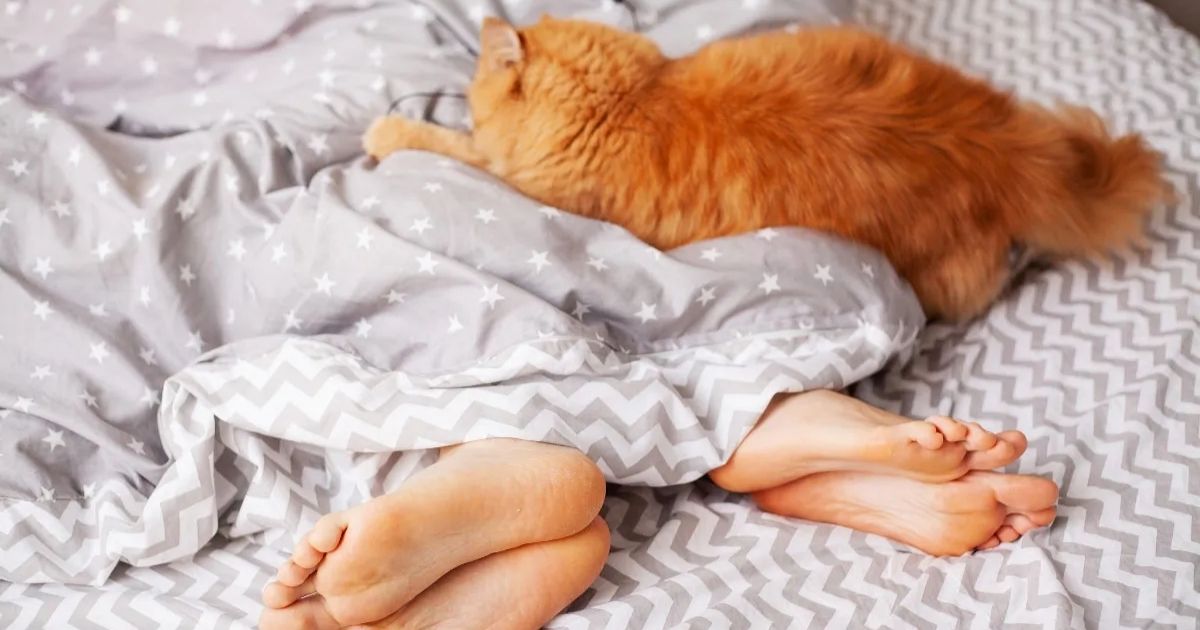
You wake up at 2 a.m. and can’t move your legs. Your cat is curled up at the foot of the bed, completely unbothered, sleeping like a king. Sound familiar?
It’s one of those things that almost every cat owner notices but rarely thinks too deeply about. Why there? Why not the pillow, the couch, or literally anywhere else in the house? The answer is actually a fascinating mix of instinct, emotion, and feline logic that makes complete sense once you understand how cats think.
Why Do Cats Sleep at Your Feet? Understanding This Common Feline Habit
If you’ve ever wondered why do cats sleep at your feet rather than sprawled across your chest or tucked beside your pillow, you’re not alone. It’s one of the most Googled cat behavior questions out there. And honestly, the answer isn’t one single thing.
Cats are layered creatures. Every choice they make, including where they sleep, reflects a combination of their survival wiring, their emotional bond with you, and their personal preferences. The foot of the bed hits a very specific sweet spot for them. It offers warmth without confinement, closeness without vulnerability, and an unobstructed view of the room.
Think about it from the cat’s perspective. You’re a trusted companion, a reliable heat source, and a symbol of safety. But cats are also fiercely independent. They don’t want to be pinned under your arm or trapped against a pillow. Sleeping near your feet lets them stay connected to you while keeping their options open. It’s the feline version of sitting close to someone you like but not quite sharing a blanket.
This habit shows up across breeds and ages. Kittens do it. Senior cats do it. Bold cats and shy cats both end up at the foot of the bed eventually. That consistency tells you it’s deeply rooted in cat behavior, not just coincidence.
Read More: The Complete Dog Poop Guide: What Color, Consistency & Contents Reveal
The Instinctive Reasons Cats Choose the Foot of the Bed
Long before your cat was curled up on your memory foam mattress, its ancestors were navigating the wild. And in the wild, where you sleep can mean life or death. Those ancient survival instincts don’t just disappear because there’s now a food bowl in the kitchen and central heating.
Cats are both predators and prey. That dual role shapes almost everything about how they move, rest, and position themselves in a space. When they sleep, they’re still semi-alert. A sound, a shift in movement, a change in the air can snap them back to attention within seconds.
The foot of the bed is instinctively appealing because it puts the cat at the edge of a larger structure rather than the center of it. In nature, sleeping in the middle of an open area is dangerous. Edges, corners, and elevated spots feel safer because they reduce the number of directions from which a threat can approach.
Your feet also move less than your hands, head, and torso during sleep. If you’ve ever been woken up by your own restless tossing, imagine being a cat lying beside your shoulder. From a cat’s instinctive sleeping behavior standpoint, the lower end of the bed is simply the calmer, more predictable zone. Less disruption means deeper rest.
This isn’t overthinking it. Cats calculate their environment constantly, even when they look completely relaxed. That curled-up ball at your feet is a finely tuned survival machine choosing its position with quiet precision.
Safety and Awareness: Why This Spot Feels Secure to Cats
Safety isn’t just physical for cats. It’s also psychological. A cat that feels exposed, watched, or cornered won’t sleep well. But a cat that feels anchored near something familiar and trustworthy? That’s a cat that can actually relax.
Your presence is that anchor. Cats that sleep near their owners are often displaying what animal behaviorists describe as a secure attachment. You represent a known quantity. Your scent, your breathing pattern, even the rhythm of your movements during sleep are all signals that tell your cat everything is fine.
Cats and nighttime security instincts go hand in hand. In the dark, when the house is quiet and sensory input is reduced, cats rely even more heavily on proximity to their trusted human. Your feet are close enough to register your presence but far enough to allow the cat to keep an eye on the rest of the room.
That positioning matters. The foot of the bed typically faces toward the bedroom door or the open space of the room. A cat sleeping there has a natural vantage point. It can see what’s coming before anything reaches you or, more importantly, before anything reaches the cat itself.
This is also why cats that feel insecure or stressed in a home often stop sleeping near their owners at all. A disruption in this habit can be a quiet signal worth paying attention to.
Warmth and Comfort: Why Your Feet Are a Cozy Sleeping Spot
Let’s be honest. Part of this is purely about warmth. Cats love heat in a way that borders on obsessive. You’ve probably seen your cat chase sunbeams across the floor or press itself against a radiator like it’s trying to merge with it. That same heat-seeking nature pulls them toward you at night.
Cats seeking warmth from owners is completely natural. Your body radiates heat constantly, and under a blanket, that warmth concentrates. The foot of the bed tends to create a pocket of warmth that’s sheltered but not smothering. It’s the Goldilocks zone of cat comfort, warm enough to be appealing, but not so close that it feels suffocating.
There’s also something to be said about texture and surface. Your blanket at the foot of the bed is often bunched, layered, and slightly irregular in shape. Cats adore surfaces like that. It lets them knead, nest, and adjust their position until everything feels just right.
And your feet themselves? They’re consistently warm, relatively still, and padded by thick socks or blankets. For a cat, that’s essentially a heated cushion that breathes. Hard to compete with that.
Cat body heat preference is a well-documented behavior. In fact, cats have a slightly higher body temperature than humans, ranging from 101 to 102.5 degrees Fahrenheit, and they constantly work to maintain it. Sleeping near a warm human reduces the energy they need to spend staying warm, which is a pretty clever biological shortcut.
A Sign of Trust: What It Means When Your Cat Sleeps Near You
Here’s the part that might actually make you feel a little emotional. When your cat chooses to sleep near you, it isn’t just seeking convenience. It’s extending trust. And for a cat, trust is not handed out freely.
Cats are not pack animals the way dogs are. They didn’t evolve to depend on others for survival. So when a cat voluntarily places itself near a human during its most vulnerable state, which is sleep, that’s a meaningful choice.
Cat affection and trust signs don’t always look the way we expect them to. There’s no tail-wagging or bounding toward the door. With cats, affection tends to be quieter. Sleeping near you is one of the clearest expressions of it.
Think of it this way. In the wild, a cat sleeping deeply is a cat that could get ambushed. Choosing to sleep near another living being, even a human, means the cat trusts that being not to startle it, harm it, or disturb its rest. That’s a big deal coming from an animal that’s wired for self-reliance.
Feline social bonding behavior is more nuanced than most people give it credit for. Cats form genuine attachments to their owners, and those attachments show up in small, consistent behaviors. Sleeping near you is one of the most consistent of all.
So the next time you wake up and find your cat posted at the foot of the bed, know that it chose to be there. It didn’t have to. It wanted to.
Why Cats Prefer Your Feet Instead of Your Lap at Night
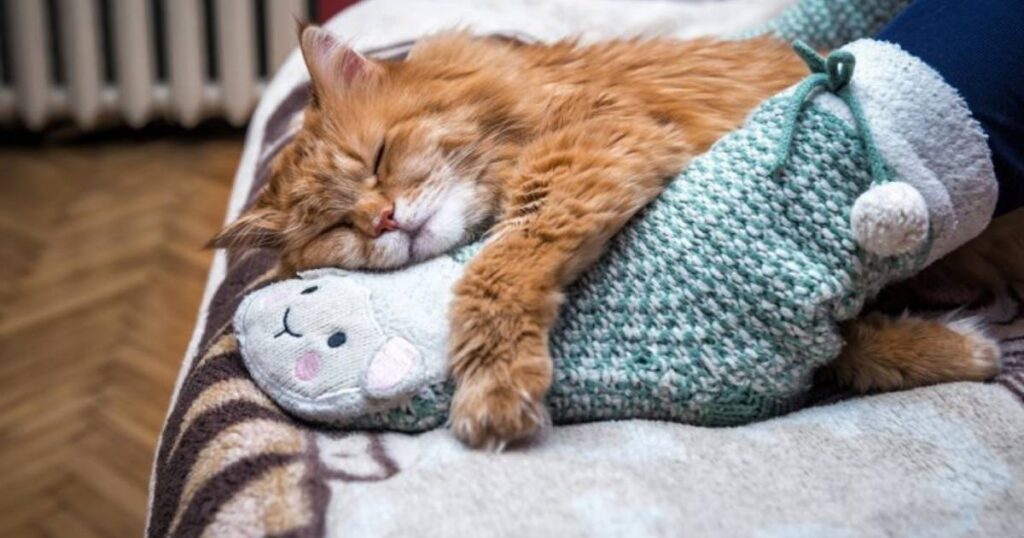
Your lap is great during the day. Warm, soft, stationary. But at night? The lap becomes a liability. Once you lie down, your lap disappears, and the cat has to make a new call about where to go.
The foot of the bed solves this problem neatly. It’s a consistent spot that doesn’t shift based on your position. Whether you sleep on your back, your side, or switch between the two all night, your feet are still more or less where they started. That predictability matters to a cat.
Cat comfort sleeping positions also factor into this. On your lap, a cat is elevated and dependent on your stillness. At your feet, the cat is on a flat, stable surface with room to stretch, readjust, and move without falling off. It has more autonomy, which cats naturally prefer.
There’s also the issue of breathing and body movement. Your head and chest area see the most activity during sleep. Breath, shifting, the occasional snore. The foot end is a quieter neighborhood, and cats are light sleepers who notice every disturbance.
Cat sleeping close but not on lap is a specific behavioral pattern that reflects the cat’s need for independence within closeness. They want to be near you. They just don’t want to be dependent on you for their physical comfort while sleeping. The foot of the bed threads that needle perfectly.
Strategic Positioning: How Cats Keep Watch While Sleeping
Cats don’t fully switch off when they sleep. Even in a deep nap, a portion of their brain stays alert. It’s an evolutionary adaptation that’s served them for thousands of years, and it doesn’t stop working just because they live indoors now.
Sleeping at the foot of the bed gives cats a strategic vantage point. From there, they can monitor the room, the doorway, and any movement in the space, all while technically being asleep. Cat guarding owner while sleeping is a real behavior, not just a charming notion. Your cat is, in some sense, keeping watch.
This positioning also allows the cat to respond quickly if needed. If something startles it, whether it’s a sound, a shift in the room, or your movement, it can spring into action from the foot of the bed without being tangled up near your body. It’s ready but resting.
Feline instincts and safety are so deeply embedded that even the most pampered indoor cat maintains them. Your cat knows, on some level, that things can change fast. Sleeping with that awareness intact is just part of being a cat.
It’s actually quite touching when you think about it. While you’re completely unconscious, your cat is maintaining a quiet vigil, keeping its senses tuned to the environment, half-protecting a space it considers home.
How Cats Choose Their Favorite Sleeping Locations
Not every sleeping spot gets chosen equally. Cats have preferences, and they arrive at those preferences through a combination of trial, instinct, and personal quirk.
Why cats choose specific sleeping spots comes down to a few core factors: warmth, safety, scent, and familiarity. A spot that hits all four tends to become a regular. Your foot of the bed often checks every box.
Cats sleeping near human scent is a particularly important piece of this puzzle. Your scent is a powerful signal to your cat. It marks you as familiar, safe, and bonded. Sleeping near the area where your scent is concentrated, including your bedding, your clothing, and your body, reinforces that sense of security.
Cats also tend to return to spots that previously gave them good experiences. If your cat slept at your feet last Tuesday and nothing bad happened, maybe it was warm, maybe you barely moved, it’s going to remember that. Cats are creatures of habit, and a positive sleeping experience creates a pull back to the same location.
Cat bed sleeping preferences can also shift over time. A cat that used to sleep on the couch might migrate to your bed as your bond deepens. That migration is meaningful. It reflects increasing trust and comfort, not just a random change of scenery.
Do All Cats Sleep at Their Owners’ Feet? Personality Differences Explained
Not every cat does this, and that’s completely normal. Cat personality and sleeping patterns vary widely, and some cats are simply more independent or less affectionate in their habits.
Bolder, more confident cats might sleep wherever they want with no regard for proximity to you. These cats feel secure in any environment and don’t feel the same pull toward closeness that more bonded cats do.
On the other end, anxious or skittish cats might avoid the bed entirely. Being on an elevated surface with a moving human is too unpredictable for them. They’d rather find a quiet corner where they feel completely in control of their surroundings.
Cat human companionship behavior also depends heavily on early socialization. Cats that were handled frequently as kittens, especially between two and seven weeks of age, tend to form stronger attachments to humans and are more likely to seek out sleeping proximity as adults.
Breed plays a role too. Ragdolls, Burmese, and Maine Coons are famously people-oriented and tend to stick close to their owners. More independent breeds, like Norwegian Forest Cats or Russian Blues, might prefer their own designated sleeping spots.
The key point is this: if your cat doesn’t sleep at your feet, it doesn’t mean the bond isn’t there. It just means your cat expresses connection differently. And if it does sleep at your feet, well, now you know exactly why.
When Changes in Your Cat’s Sleeping Habits Might Signal a Problem
Cat sleeping habits explained through a health lens look a little different. A sudden shift in where or how your cat sleeps can be an early warning sign worth noticing.
If your cat has always slept at your feet and suddenly stops, pay attention. It might be nothing. Maybe the room got warmer, or your cat found a new favorite spot. But it could also indicate discomfort, pain, or early illness.
Cats that are experiencing joint pain, for example, may avoid elevated surfaces like the bed because jumping becomes difficult or painful. Cats with respiratory issues might seek cooler spots on the floor. Cats under emotional stress might withdraw entirely and sleep in hidden areas.
Cat sleeping habit changes can also be triggered by changes in the household. A new pet, a new person, a change in routine, or even rearranged furniture can unsettle a cat enough to alter its sleeping behavior.
Also watch for excessive sleeping. While cats sleep a lot anyway, ranging from 12 to 16 hours per day, a noticeable increase combined with other symptoms like loss of appetite or behavior changes warrants a vet visit.
Trust your instincts here. You know your cat’s baseline better than anyone. If something feels off about its sleeping routine, take it seriously. Cats are masters at hiding discomfort, and sleep behavior changes are often one of the first cracks in that mask.
Tips to Help Your Cat Sleep Comfortably Without Disturbing Your Rest
Loving your cat’s company doesn’t mean you have to sacrifice sleep quality. There are ways to make the arrangement work for both of you.
First, give your cat a defined spot. A small folded blanket or a low-profile cat bed at the foot of your bed gives your cat a dedicated, cozy area without taking over your entire sleeping space. Cats often respond well to having something that feels distinctly theirs.
Second, establish a consistent bedtime routine. Cats thrive on predictability. A short play session before bed helps burn off any residual energy, and a small snack afterward can trigger the natural post-hunt drowsiness that leads to deeper, longer sleep. This reduces the chances of your cat deciding 3 a.m. is the perfect time to sprint across your legs.
Third, if your cat keeps disturbing your sleep through pawing, kneading, or repositioning, consider whether it’s getting enough stimulation during the day. A bored cat is a restless cat. Enrichment during waking hours leads to calmer nights.
If you’d prefer your cat not sleep in your room at all, introduce that change gradually. Don’t just shut the door one night. Instead, create an appealing alternative sleeping space outside the room and spend a few days making it enticing with familiar-smelling bedding and a comfortable surface.
And if you’re perfectly happy with your cat at your feet, enjoy it. It’s a sign of a healthy, trusting bond. That warm weight at the end of the bed? That’s affection, feline style.
FAQ’s
Why do cats sleep at the foot of the bed and not closer to your head?
Cats prefer the foot of the bed because it’s calmer, involves less movement, and gives them a clear view of the room. It balances closeness to you with personal space and an easy escape route if needed.
Is it healthy to let your cat sleep in your bed?
For most people, yes. Sharing a bed with a healthy, regularly vetted cat poses minimal health risk and can actually reduce stress. Those with allergies or compromised immune systems should consult a doctor first.
Does my cat sleeping at my feet mean it loves me?
Absolutely. Choosing to sleep near you during a cat’s most vulnerable state is a clear expression of trust and affection. It’s one of the more meaningful ways cats show they feel safe with you.
Why does my cat sleep at my feet but not my partner’s?
Cats tend to bond most strongly with the person they associate with feeding, play, and comfort. If you’re the primary caretaker, your cat likely gravitates toward your scent and presence naturally.
Should I be worried if my cat suddenly stops sleeping at my feet?
A sudden change in sleeping habits can sometimes signal a health issue, stress, or environmental change. If the shift is accompanied by other behavioral changes or physical symptoms, a vet check is a smart move.

Caleb Ford is pet enthusiast and content strategist who blends real-world pet care experience with digital expertise. He’s known for crafting reliable, research-based articles that inform and inspire pet owners. Caleb’s approach centers on transparency, compassion, and trust key pillars of authentic EEAT-driven storytelling in the pet industry.